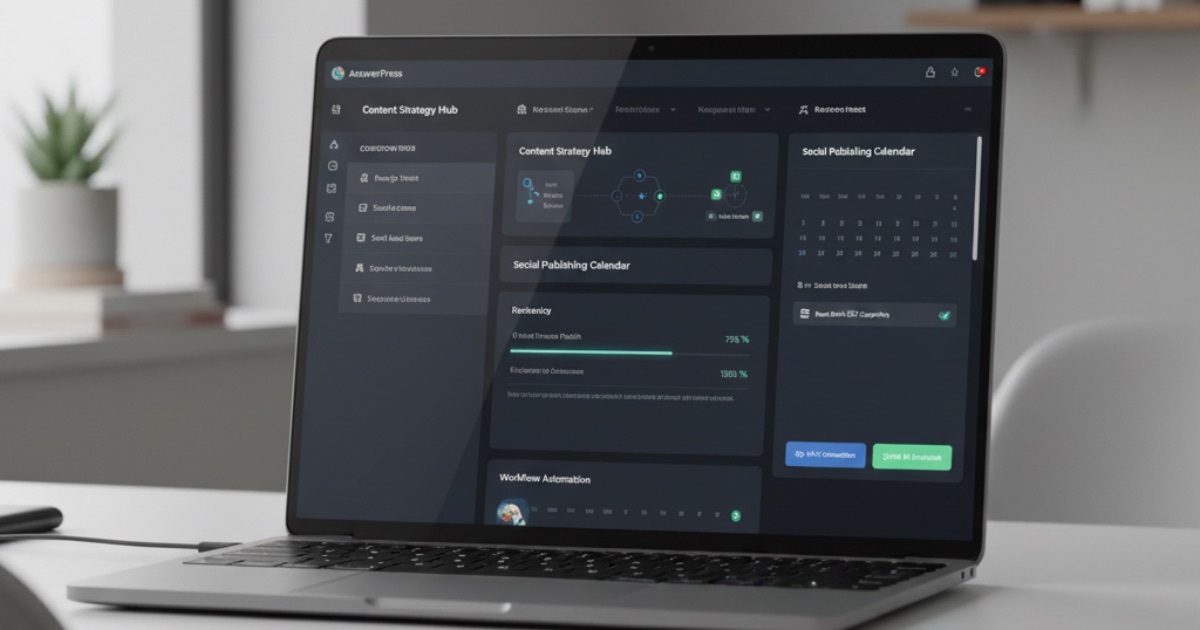

Most agencies didn’t set out to build fragmented tool stacks. It happened gradually: a writing assistant here, a reporting dashboard there, a social scheduling tool bolted on the side. By 2026, the average mid-size agency runs eight to twelve discrete software products, and the humans in between are the integration layer. That is an expensive way to operate, and it is becoming unsustainable.
AI workflow automation changes the equation. Not by replacing your team, but by eliminating the connective tissue work that consumes senior hours without producing senior-level output. The agencies pulling ahead this year are the ones that stopped treating AI as a collection of point solutions and started treating it as a coordinated system.
This article breaks down how to implement that system, section by section, so you can move from scattered adoption to a coherent operational model.
Why Fragmented AI Adoption Is Costing Agencies More Than They Realize
A tool that saves a copywriter two hours per week sounds like a win. Multiply that across eight tools, each with its own interface, login, and output format, and you have created a new category of overhead: tool management. Someone has to configure each product, QA its output, and stitch the results into a deliverable the client can actually use.
This is the hidden cost of piecemeal AI adoption. The efficiency gains at the task level get consumed by coordination friction at the workflow level. Agencies that have audited this honestly tend to find that their net time savings from AI tools are far smaller than expected, because no single tool owns the full decision chain.
The agencies gaining operational leverage in 2026 are not the ones with the most AI tools. They are the ones with the fewest handoffs between those tools.
The shift required is architectural. Instead of asking “which task can AI help with?”, the productive question is “which workflows can AI own end to end?” That reframe changes which tools you buy, how you structure your team, and how you price your services.
The Case for Multi-Agent AI Systems in Agency Operations
Single-task AI tools are useful. Multi-agent AI systems are a different category of capability entirely. A multi-agent system assigns specialized AI agents to distinct roles within a workflow, then coordinates their outputs toward a shared outcome. One agent researches, another drafts, a third applies SEO logic, and an orchestration layer sequences the work and handles exceptions.
According to Rainstream Web’s 2026 analysis of AI in the agency landscape, the rise of AI agents working in coordinated teams is significantly restructuring how agencies deliver work, enabling the coordination of complete workflows that previously required multiple human specialists.
For agencies, this has a direct implication for service delivery. A workflow that once required a strategist, a writer, an SEO specialist, and a project manager can now be partially or substantially handled by a coordinated agent system, with human review at defined checkpoints rather than at every step.
What Multi-Agent Coordination Looks Like in Practice
Consider a standard content campaign for a B2B client. The traditional workflow involves separate briefing, research, writing, editing, SEO review, and publishing steps, each handed off between people. A multi-agent system compresses this into a single coordinated run, with agents handling each stage and a human reviewer approving the output before it goes live.
The practical result is not just speed. It is consistency. Every article produced by the system follows the same structural logic, applies the same schema rules, and targets the same topical authority framework. Human reviewers shift from doing the work to auditing and improving the system that does the work.
For a deeper look at how to evaluate and select the right platforms for this kind of coordination, the comparison of workflow orchestration platforms built for agency operations covers the key criteria in detail.
Restructuring Service Delivery Around AI Workflow Automation
Implementing AI workflow automation at scale requires rethinking how services are structured, not just how they are produced. Agencies that simply layer AI tools onto existing service models will see modest gains. Agencies that redesign their service models around AI capabilities will see structural improvements in margin and capacity.
The shift typically moves through three stages:
- Task automation: Individual tools handle discrete outputs (drafts, reports, social posts). Humans still own the workflow logic and sequencing.
- Workflow automation: Coordinated systems handle multi-step processes end to end. Humans define the rules and review final outputs.
- Service productization: Repeatable, AI-powered workflows are packaged as fixed-scope offerings with predictable delivery times and costs, enabling value-based pricing.
Most agencies are somewhere between stages one and two. The agencies achieving the strongest margin improvements in 2026 are the ones reaching stage three, where the workflow itself becomes the product.
Value-Based Pricing Becomes Viable at Stage Three
Hourly billing is a direct measure of labor input. When AI compresses the labor required to produce a deliverable, hourly billing punishes the agency for its own efficiency. Value-based pricing, by contrast, prices the outcome rather than the hours.
AI workflow automation makes value-based pricing operationally feasible because it standardizes production. When you know that a content campaign will take a defined number of agent runs, review cycles, and publishing steps, you can price it as a fixed deliverable with a known cost basis. The margin improvement is structural, not incidental.
This model also changes the client relationship. Instead of billing for time spent, you are billing for outcomes delivered. That is a more defensible position, especially as clients become more aware of AI’s role in production.
Building a Proactive AI Adoption Strategy
Reactive AI adoption, buying tools in response to competitive pressure or client requests, produces the fragmented stack described earlier. A proactive strategy starts with workflow mapping and works backward to tool selection.
Building a proactive AI adoption strategy for agentic AI success requires agencies to answer four questions before selecting any tool:
- Which workflows currently consume the most senior time for the least strategic value?
- Which of those workflows have clearly defined inputs, outputs, and quality criteria?
- Where do handoffs between team members create delays or quality inconsistencies?
- Which client deliverables are repeatable enough to be productized?
The answers to these questions define your automation roadmap. They also reveal which workflows are ready for AI coordination and which still require human judgment at every step.
Sequencing the Implementation
Not every workflow should be automated simultaneously. A sensible sequencing approach prioritizes by two criteria: volume (how often does this workflow run?) and standardization (how consistent are the inputs and outputs?).
High-volume, high-standardization workflows are the first candidates. Monthly reporting, content production for established clients, and keyword research are typical examples. Lower-volume or highly customized workflows, such as new client strategy development, are better candidates for AI assistance rather than full automation.
Google Cloud’s 2026 report on agentic AI trends frames this well, noting that the most durable implementations focus on enabling sustainable, efficient, and resilient data-driven operations rather than chasing maximum automation for its own sake. Sustainability matters because over-automated workflows that produce inconsistent quality create client trust problems that are expensive to repair.
AEO Integration: Why Content Workflows Must Account for AI Answer Engines
Any agency implementing AI workflow automation in 2026 needs to account for the shift from SEO to Answer Engine Optimization (AEO). The content that AI workflow systems produce must be structured to earn citations in AI-generated answers, not just to rank in traditional search results.
This changes the technical requirements for content workflows. Schema markup, structured data, and topical authority frameworks are no longer optional post-production tasks. They need to be built into the workflow logic from the start, so that every piece of content produced by the system is structured correctly by default.
For agencies managing content at scale, this is a significant operational shift. It means the AI workflow automation system needs to apply SEO and AEO rules at the production stage, not as a separate review step. The two disciplines need to be unified in the workflow, not siloed into separate tools.
Agencies evaluating platforms for this kind of integrated content production should review the landscape of AI agent platforms built specifically for agency operations, which covers how leading systems handle the AEO requirements that general-purpose AI writers miss.
Niche Specialization as a Competitive Advantage
One underappreciated consequence of AI workflow automation is that it lowers the cost of deep specialization. Historically, building expertise in a niche required investing significant human hours in research, content production, and client education. AI systems can now handle much of that production work, freeing senior staff to develop and apply the strategic insight that defines expertise.
Agencies that specialize in a defined niche can train their AI workflow systems on domain-specific terminology, client profiles, and content standards. The result is output quality that a generalist agency using generic AI tools cannot match, even if both teams use similar underlying models.
This is a durable competitive advantage. Niche specialization combined with a well-configured AI workflow system creates a production capability that is difficult to replicate quickly. It also supports value-based pricing, because clients in specialized industries will pay for demonstrable domain expertise rather than generic content volume.
Measuring the Impact of AI Workflow Automation
Implementation without measurement produces anecdote rather than evidence. Agencies should define success metrics before deploying any automated workflow, so that performance can be assessed against a baseline rather than a feeling.
The most useful metrics for agency AI workflow automation fall into three categories:
- Efficiency metrics: Time from brief to publish-ready deliverable; number of revision cycles per project; senior staff hours per client deliverable.
- Quality metrics: Client approval rate on first submission; error rate in published content; consistency of brand voice and structural standards across deliverables.
- Business metrics: Gross margin per service line; client retention rate; revenue per full-time equivalent team member.
Efficiency metrics tell you whether the system is working. Quality metrics tell you whether it is working well. Business metrics tell you whether it is working profitably. All three are required for a complete picture.
Conclusion: Automation as a Business Model Decision
AI workflow automation in 2026 is not primarily a technology decision. It is a business model decision. The agencies that will build durable competitive positions are the ones that treat automation as a structural redesign of how they deliver value, not as a productivity shortcut layered onto existing processes.
The path forward is clear: map your workflows, identify the highest-value automation opportunities, implement coordinated multi-agent systems rather than isolated tools, and package the results as productized services priced on outcomes. That sequence produces margin improvement, capacity growth, and a client relationship built on results rather than hours.
If your agency is ready to move from scattered AI adoption to a coordinated strategy, AnswerPress is built for exactly that transition. It handles the full content decision chain, integrates natively with WordPress and Rank Math, and produces publish-ready content structured for both traditional search and AI answer engines. Reach out to the AnswerPress team to see how the system fits your agency’s workflow.
Frequently Asked Questions
What is AI workflow automation for agencies?
AI workflow automation is a system that uses coordinated AI agents to handle multi-step processes from start to finish, rather than relying on individual tools for single tasks. It eliminates connective tissue work that consumes senior hours without producing senior-level output, allowing agencies to focus on strategic tasks.
How does fragmented AI adoption cost agencies more than they realize?
Fragmented AI adoption leads to hidden costs through tool management overhead, including configuration, output QA, and integrating results from multiple disparate tools. The efficiency gains at the task level are often consumed by coordination friction at the workflow level, resulting in smaller net time savings than expected.
What is the difference between single-task AI tools and multi-agent AI systems?
Single-task AI tools assist with discrete outputs like drafting or reporting, but humans still manage the workflow logic. Multi-agent AI systems assign specialized agents to distinct roles within a workflow and coordinate their outputs toward a shared outcome, enabling the coordination of complete workflows that previously required multiple human specialists.
How does AI workflow automation enable value-based pricing?
AI workflow automation makes value-based pricing operationally feasible by standardizing production processes. When AI can consistently deliver a defined outcome with predictable steps, agencies can price services as fixed deliverables based on value, rather than billing for hours spent, which can be a disadvantage when AI increases efficiency.
What is the shift from SEO to Answer Engine Optimization (AEO) and how does it impact content workflows?
The shift to AEO means content must be structured to earn citations in AI-generated answers, not just rank in traditional search. This requires integrating schema markup, structured data, and topical authority frameworks directly into AI workflow logic from the start, ensuring content is correctly structured by default rather than as a post-production task.