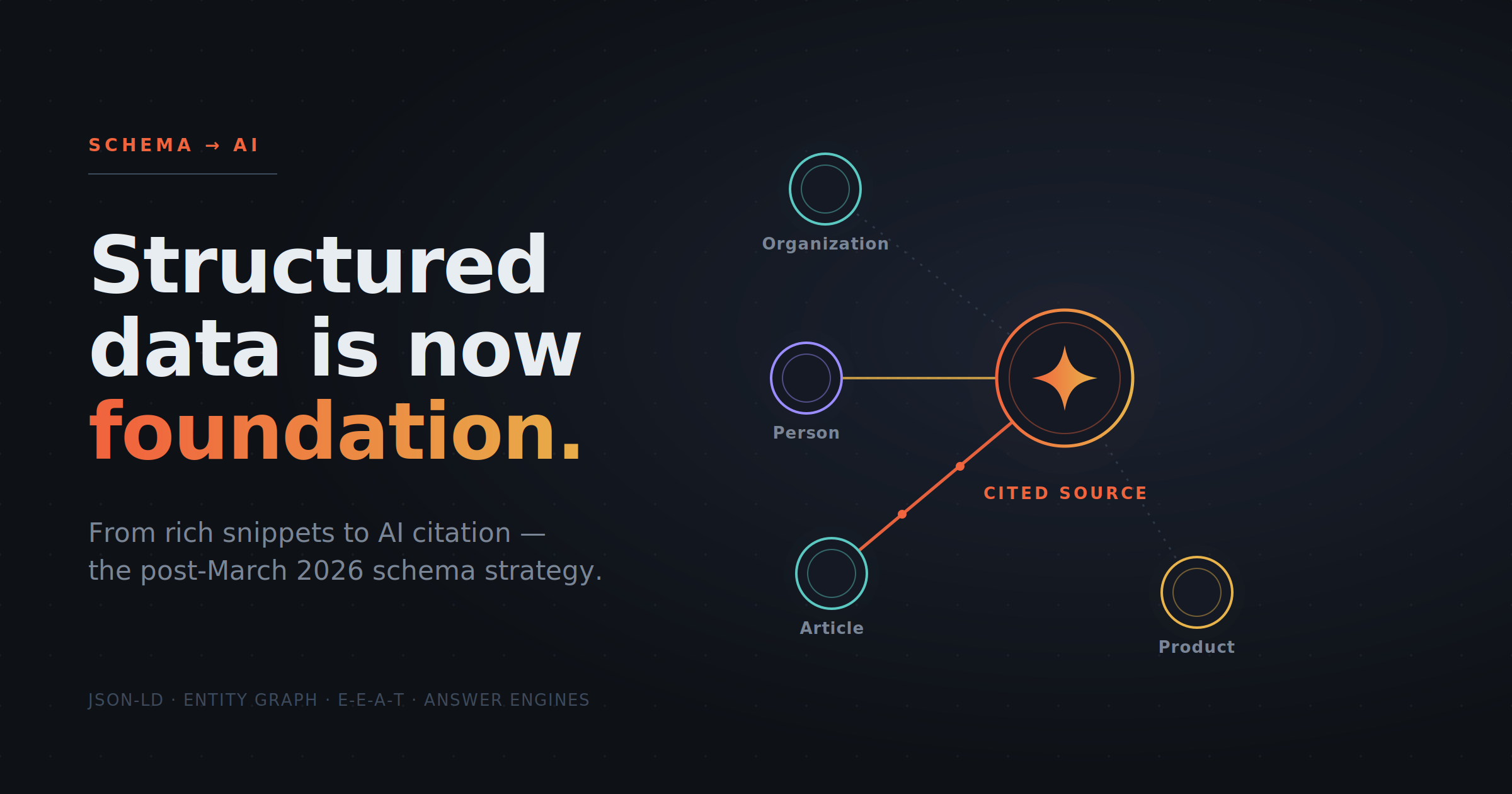

The Google core update that rolled out from March 27 to April 8, 2026, was not a routine tremor. It was a clear signal that the ground had been fundamentally restructured. For years, web professionals have used structured data to chase rich snippets, hoping for a visual edge in the ten blue links. That era is over. The March update, along with its surrounding changes, cemented a new reality: your approach to SEO structured data is no longer about decoration. It is about dictating how AI understands, trusts, and cites your content.
If your team is still focused on how schema affects your search results, you are asking the wrong question. The right question is whether your structured data is robust enough to make your website a primary source for Google’s AI Overviews and other generative answer engines. The game has shifted from visibility in a list to citation in an answer. This requires a strategic overhaul, not just a technical tweak.
The March 2026 Updates: A Recap of Google’s Recalibration
To understand the current state of structured data, we must view it in the context of Google’s recent activities. The March 2026 core update was not an isolated event. It was the culmination of several targeted adjustments designed to reshape how content is evaluated and presented, with a clear bias towards AI-driven interpretation.
The sequence of events tells a story:
- February 2026 Discover-only Core Update: Google’s first announced update targeting only the Discover feed. It focused on reducing clickbait and rewarding original reporting, narrowing the pool of authoritative sites in US Discover feeds from 172 to just 158 unique domains. This was a clear move to prioritize a smaller set of trusted sources.
- March 2026 Spam Update (March 24-25): Just before the main event, Google executed its shortest confirmed spam update, concluding in under 20 hours. This rapid surgical strike cleared the field of low-quality and manipulative content, setting a cleaner stage for the core update to follow.
- March 2026 Core Update (March 27 – April 8): The main 12-day rollout was described as a “regular recalibration” to better surface satisfying content. Yet its impact was significant, with early data showing that over 55 percent of monitored sites experienced changes in ranking. This recalibration happened on a field already tilted towards AI-vetted authority.
Concurrent with these algorithm changes, the technical environment also evolved. The Schema.org vocabulary released version 30.0 on March 19, 2026, introducing new classes like `Credential` and `Error`. While many of these are specialized, they show the ongoing expansion of machine-readable language. This cluster of updates signals a unified push towards a search ecosystem that relies heavily on explicit signals of trust, expertise, and factual accuracy, all of which are communicated through data.
Beyond Rich Snippets: The New Role of SEO Structured Data
For a decade, the primary motivation for implementing structured data was to win rich results. Star ratings, FAQ dropdowns, and recipe cards were visual enhancements that could improve click-through rates. While some of these still exist, their importance has been eclipsed by a far more critical function. Today, properly implemented SEO structured data is about becoming a canonical source for answer engines.
The official retirement of FAQ rich results, confirmed by Google on May 7, 2026, is a perfect illustration of this shift. For months prior, SEOs noted that FAQ impressions had dropped by nearly half. Google did not stop wanting the Q&A content; it just stopped feeling obligated to display it in the format you provided. Instead, it now ingests that structured information to train its own models and formulate its own answers for AI Overviews. You are no longer decorating a SERP entry; you are feeding a knowledge base.
Structured data has transitioned from a tool for visual SERP enhancement to a foundational requirement for AI citation. Its primary purpose is no longer to secure a rich snippet but to establish your content as a verifiable, machine-readable source of truth that AI models can trust and reference.
This new reality means your schema must be more comprehensive and accurate than ever. AI models use it to verify claims, establish relationships among entities (such as a company, its founder, and its products), and assess source credibility. An analysis by Digital Applied on the impact of the March 2026 update on structured data confirms this strategic pivot. It highlights that websites with robust and precise schema are better positioned to be cited in AI-generated answers, a benefit that far outweighs a simple, visually rich result.
How AI Overviews Are Changing Structured Data Priorities
With AI expected to handle 25 percent of global search queries by the end of 2026, optimizing for AI Overviews is not optional. This requires a shift in how you think about and implement structured data. The old goal was to stand out in a list of links. The new goal is to become the source behind the answer.
From Visual Enhancement to Foundational Trust Signal
The decline of some rich result types does not mean structured data is less important. It means its purpose has matured. Instead of serving as a visual hook for a human user, it now functions as a trust-and-verification layer for an AI. When Google’s Gemini-powered systems synthesize an answer, they use schema to cross-reference facts and understand the context of information. Some analyses after the March update noted a citation lift of up to 3.2x for content with well-implemented schema. This is the new ROI of structured data.
Which Schema Types Matter Most Now?
While Google still actively supports 31 schema types for rich results, the strategic focus should be on the schema that builds entity understanding. This is about clearly defining “who” and “what” your content is about in a way a machine can parse. Prioritize these types:
- `Organization` and `LocalBusiness`: Clearly define your business entity, including your official name, logo, address, contact information, and `sameAs` properties linking to your official social media profiles and knowledge graph entries.
- `Person`: For key authors or experts, use the `Person` schema to specify their name, job title, and `sameAs` links to their professional profiles (like LinkedIn) and author pages. This directly supports E-E-A-T signals.
- `Article`: Go beyond the basics. Use `author` and `publisher` properties that point to nested `Person` and `Organization` schema. Use `datePublished` and `dateModified` to signal freshness.
- `Product`: For e-commerce, a detailed `Product` schema with `offers`, `aggregateRating`, and `review` properties is critical for both traditional snippets and AI product comparisons.
The goal is to create a web of interconnected, verifiable data points. This deep, relational structure is essential for the success of semantic search, allowing search engines to understand not just keywords but also concepts and relationships.
The Retirement of the FAQ Schema and What It Signals
The deprecation of the visual FAQ snippet is a crucial lesson. It demonstrates that Google sees structured data as a resource for its own use. By providing clear question-and-answer pairs in your schema, you are directly training the AI on how to respond to user queries. While you no longer get the dedicated visual space in the SERP, your content is more likely to be integrated into an AI Overview. The strategy is no longer to own the SERP space, but to influence the AI-generated answer.
Practical Steps to Adapt Your SEO Structured Data Strategy
Adapting to this new environment requires a disciplined, systematic approach. A reactive or piecemeal implementation of the schema will not suffice. The following steps provide a framework for creating a robust SEO structured data strategy that aligns with the post-update landscape.
- Audit Your Existing Schema: Use tools such as Google’s Rich Results Test and the Schema Markup Validator to conduct a comprehensive audit of your site. Do not just look for errors. Identify warnings, deprecated schema types, and opportunities to add more specific properties to your existing markup.
- Prioritize Entity-Level Markup: Shift your focus from page-level decoration to site-level entity definition. Use `Organization` and `Person` schema with `sameAs` properties to explicitly connect your website to other authoritative online profiles. This technical work is fundamental to strengthening your site’s SEO topical authority and demonstrating your entity’s credibility to search engines.
- Align Schema with On-Page Content: Your structured data must accurately reflect the content visible to the user. Do not add `Review` schema to a page without visible reviews. Do not inject keywords into JSON-LD that are not present in the body copy. This alignment is a critical trust signal for both users and algorithms.
- Adopt New and Relevant Properties: The structured data vocabulary is not static. Stay informed about updates from Schema.org. The release of version 30.0 introduced new classes like `Credential`, which could be powerful for demonstrating author expertise. Regularly review your implementation to see if new properties can add more context and specificity.
- Monitor Performance and Adapt: Use Google Search Console to track the performance of your schema-enhanced pages. Pay close attention to the Performance report, filtering by different search appearances. A drop in impressions for a specific rich result type could signal a change in Google’s priorities, as was the case with FAQ snippets. This data-driven approach aligns with broader SEO best practices for 2026 and ensures your strategy remains effective.
The Connection Between Structured Data, E-E-A-T, and Topical Authority
The March 2026 updates reinforced the importance of E-E-A-T (Experience, Expertise, Authoritativeness, and Trustworthiness). SEO structured data is the technical mechanism you use to prove these qualities to a machine. It translates abstract concepts of authority and trust into concrete data points that an algorithm can process and validate.
For example, simply stating an author’s name in the byline is a weak signal. Using `Article` schema with a nested `Person` schema, which includes the author’s `jobTitle` and `sameAs` links to their academic papers or professional profile, is a strong, verifiable signal of expertise. Similarly, a robust `Organization` schema helps Google understand that your brand is a legitimate, trustworthy entity.
When this approach is applied consistently across your entire site, it does more than just optimize individual pages. It builds a machine-readable map of your expertise. This map demonstrates your topical authority by showing the depth and breadth of your knowledge on a subject. It is a critical component of optimizing your content for new AI search platforms, as they are more likely to cite sources that demonstrate comprehensive authority.
Conclusion: From Decoration to Foundation
The changes throughout early 2026, culminating in the March core update, were not about punishing old techniques. They were about rewarding a new level of clarity and authority. Effective SEO structured data is no longer a nice-to-have feature for securing visual flair in search results. It is a non-negotiable, foundational element of any content strategy that aims for visibility and credibility in an AI-first search world.
The objective has shifted. The goal is not merely to rank in a list of links but to be the trusted source cited within the AI-generated answer. This requires moving beyond simple schema implementation and adopting a comprehensive strategy that defines your entities, proves your expertise, and builds verifiable trust with search engines. Your data is your new resume, and it is being reviewed by a machine.
Stop guessing. Start strategizing. AnswerPress is the strategy engine built for this new era of search, helping you create data-driven content that gets found by users and recommended by AI.
Frequently Asked Questions
What was the main impact of Google’s March 2026 update on SEO structured data?
The March 2026 update fundamentally shifted the purpose of SEO structured data from achieving visual rich snippets to establishing content as a primary source for AI understanding and citation. The focus is now on how AI trusts and uses your data, rather than how it decorates search results.
How has the role of structured data changed for AI Overviews?
Structured data now serves as a foundational trust signal for AI, helping models verify facts and understand context when synthesizing answers for AI Overviews. It has transitioned from a visual enhancement tool to a critical layer for establishing credibility and enabling AI citation.
Which types of structured data are most important after the March 2026 update?
The most important schema types now focus on building entity understanding for machines. Prioritize `Organization`, `LocalBusiness`, `Person`, `Article`, and `Product` schema to clearly define your business, authors, content, and offerings, linking them to authoritative online profiles.
What does the retirement of FAQ rich results signal for structured data strategy?
The deprecation of FAQ rich results signals that Google views structured data primarily as a resource for its AI models, not just for visual SERP enhancement. While you may not get a dedicated visual space, providing clear Q&A in schema helps train AI and increases the likelihood of your content being integrated into AI Overviews.
How can I audit and adapt my current structured data for the new AI-focused search environment?
Audit your existing schema using tools like Google’s Rich Results Test and Schema Markup Validator, focusing on accuracy and completeness. Prioritize entity-level markup like `Organization` and `Person` with `sameAs` properties, and ensure your schema accurately reflects on-page content to build trust and topical authority.