
Most WordPress publishers are still measuring success by the same metric they used in 2018: organic clicks. That metric is now an incomplete picture. As of early 2024, approximately 43.2 percent of all websites globally run on WordPress, and a large share of those sites are watching their click-through rates erode while their keyword rankings hold steady. The explanation is not a penalty or a technical failure. It is a structural shift in how search works.
Zero click SEO is the discipline of earning visibility inside search results, AI Overviews, and featured snippets, even when users never visit your site. According to toolstofind.com’s 2026 zero-click SEO strategy guide, AI-driven search is fundamentally reshaping how brands build authority online. The question for WordPress publishers is no longer whether to adapt. It is how to adapt, specifically and quickly.
This article covers five concrete strategies you can implement on a WordPress site right now to earn that visibility, build brand authority, and stay cited by AI systems that are increasingly deciding what users see first.
What Zero Click SEO Actually Means for WordPress Publishers
A zero-click search is any query that resolves on the search results page itself. The user gets an answer, a map result, a featured snippet, or an AI Overview, and never clicks a link. Back in 2020, SparkToro estimated that over 50 percent of Google searches ended without a click. Semrush’s 2022 dataset put the figure at roughly 25.6 percent of desktop searches and 17.3 percent of mobile searches in their sample, reflecting methodological differences rather than a contradiction.
Regardless of which figure you anchor to, the directional trend is clear and accelerating. Google’s AI Overviews, which consolidate answers from multiple sources into a single AI-generated response, have pushed zero-click behavior further into high-intent, informational queries. Those are precisely the queries WordPress content sites have historically relied on for traffic.
The strategic response is not to abandon content production. It is to produce content that AI systems can extract, cite, and surface. Adapting your strategy for AI answer engines means rethinking what a successful piece of content looks like: not just a page that ranks, but a source that gets recommended.
Strategy 1: Structure Content So AI Can Extract It
AI systems do not read your content the way a human does. They parse structure, identify discrete answers, and pull the clearest response to a specific query. If your content is written in long, flowing prose without clear structural signals, it is harder to cite. Structuring for extraction is the first practical step in zero click SEO.
Use Question-Based Headings
Write H2 and H3 headings as direct questions that match how users phrase queries. “What is structured data?” performs better in featured snippet competition than “An Introduction to Structured Data.” The question heading tells Google exactly what the following paragraph answers.
Follow each question heading with a concise, direct answer in the first two sentences. Elaboration can follow, but the extractable answer must come first. AI Overviews pull the most direct response, not the most comprehensive one.
Write Answer-First Paragraphs
Journalism calls this the inverted pyramid. For zero-click optimization, it is a technical requirement. Lead every section with the conclusion, then support it with evidence. A paragraph that buries its point in sentence four is one AI systems will skip in favor of a competitor’s cleaner response.
Keep answer paragraphs between 40 and 60 words where possible. That length matches the typical featured snippet character count and fits comfortably inside an AI Overview citation block.
Strategy 2: Implement Schema Markup Systematically
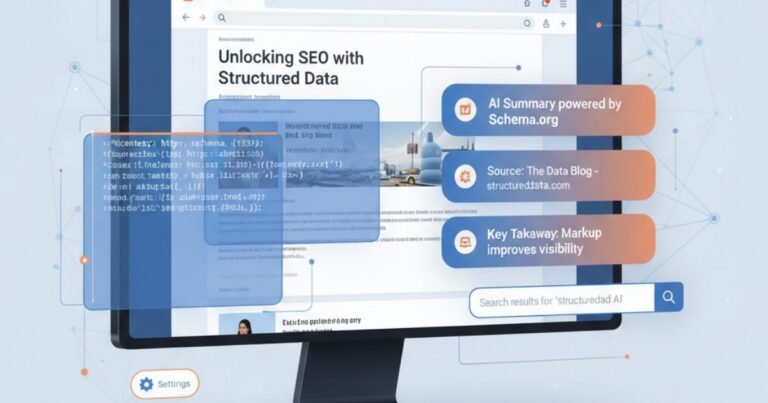
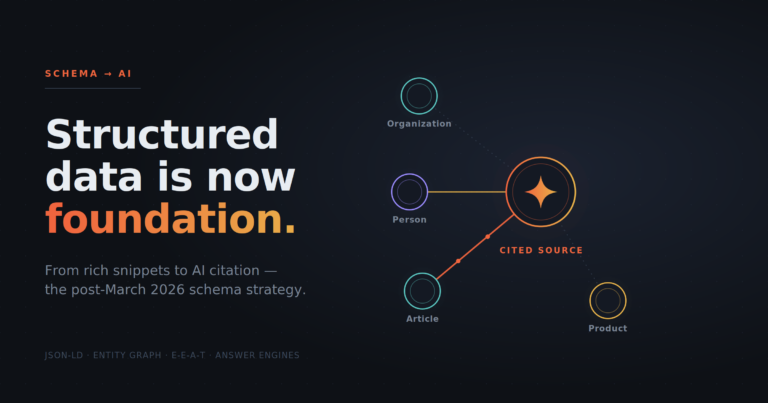
Structured data is the clearest signal you can send to an AI system about what your content means. Schema markup in JSON-LD format tells Google, ChatGPT, and other AI engines not just what your page says, but what category of information it contains and how its components relate to each other.
For WordPress publishers, Rank Math handles schema generation natively and integrates directly with the WordPress editor. But the plugin only helps if you are applying the right schema types to the right content. Defaulting to the generic Article schema on every post leaves significant visibility on the table.
Schema Types That Drive Zero-Click Visibility
Match your schema type to your content format. The most effective types for earning AI citations include:
- FAQPage: For posts that answer multiple distinct questions. Each Q&A pair becomes a discrete extractable unit.
- HowTo: For step-by-step instructional content. Steps appear in rich results and AI Overviews.
- Article with speakable: Flags specific passages as ideal for voice and AI extraction.
- LocalBusiness: Essential for any business with a physical location or service area. See the detailed breakdown of seven essential local business schema properties for implementation specifics.
Audit your existing posts in Rank Math and assign the correct schema type to each one. A post about “how to install a WordPress plugin” should use HowTo, not Article. That single change can shift whether the content appears as a rich result or sits in the standard blue-link stack.
Strategy 3: Optimize Specifically for Google AI Overviews
AI Overviews are now the primary zero-click surface for informational queries. They appear above organic results, consolidate information from multiple sources, and cite a small number of pages. Getting cited there requires a different approach than ranking in position one of traditional results.
The core requirement is topical authority combined with clear factual structure. AI Overviews favor sources that cover a topic comprehensively, present facts without ambiguity, and demonstrate expertise through specific, verifiable claims. Thin content and vague generalizations are filtered out, not ranked lower.
Practical Steps for AI Overview Optimization
- Write a concise definition of your topic in the first 100 words of the post. AI systems often pull this as the introductory citation.
- Include specific numbers, named sources, and dates. Vague claims (“many studies show”) are less citable than “Semrush’s 2022 dataset found 25.6 percent of desktop searches were zero-click.”
- Use bullet lists and numbered steps for any process or comparison. These formats are structurally easier to extract than prose equivalents.
- Add an FAQ section at the bottom of each post using FAQPage schema. This gives AI systems a ready-made set of discrete answers to pull.
- Avoid contradicting yourself within a single post. AI systems favor internally consistent sources.
For a deeper breakdown of the full optimization process, the 10-tip guide to optimizing for AI Overviews covers the complete technical and content checklist.
Strategy 4: Build Core Web Vitals Performance on WordPress
Page experience signals remain part of Google’s ranking criteria, and they influence whether a page is considered a credible source for AI citation. A slow, unresponsive page signals lower quality, even if the content itself is strong. For WordPress publishers, Core Web Vitals performance is a technical prerequisite for zero click SEO success.
On March 12, 2024, Google replaced First Input Delay with Interaction to Next Paint as an official Core Web Vital. INP measures the responsiveness of every user interaction, not just the first one. WordPress sites with heavy JavaScript, slow server response times, or unoptimized plugins are the most exposed to INP failures.
WordPress-Specific Performance Fixes
The most common INP problems on WordPress sites trace back to a predictable set of causes. Address these in order:
- Plugin bloat: Audit active plugins and deactivate any that add JavaScript to the front end without a clear performance benefit. Use Query Monitor to identify which plugins are generating slow database queries.
- Render-blocking scripts: Use a caching plugin (WP Rocket or LiteSpeed Cache) to defer non-critical JavaScript. Most themes load scripts synchronously by default.
- Image optimization: Convert images to WebP format and implement lazy loading. Unoptimized images remain the single most common Largest Contentful Paint failure on WordPress sites.
- Hosting environment: Shared hosting plans frequently fail INP thresholds under moderate traffic. Managed WordPress hosting with server-side caching is worth the cost difference for any site targeting AI citation.
Run your site through Google’s PageSpeed Insights after each change. Target an INP score below 200 milliseconds for a “Good” rating. Sites scoring in the “Needs Improvement” range (200 to 500 ms) are at a disadvantage in both traditional ranking and AI source selection.
Strategy 5: Develop Topical Authority Through Content Depth
A single well-optimized post is not enough to earn consistent AI citations. AI systems favor sources that demonstrate deep, sustained expertise across a topic area. This is what SEO practitioners call topical authority, and it is one of the most durable competitive advantages available to WordPress publishers who commit to it.
Topical authority is built through a cluster model: one comprehensive pillar page covering a broad topic, supported by multiple supporting posts that address specific subtopics in depth. The internal linking between these pages signals to Google that your site is a primary source on the subject, not a one-off contributor.
How to Build a Content Cluster for Zero-Click Visibility
The process is straightforward, but it requires planning before you publish. Improvising a cluster after the fact produces a weaker internal linking structure and inconsistent coverage.
- Choose a topic where your site can realistically claim expertise based on existing content and business context.
- Map out the ten to 15 specific questions users ask about that topic. These become your supporting post topics.
- Write the pillar page first. It should answer the broad topic question at a high level and link to each supporting post.
- Publish supporting posts in sequence, linking each one back to the pillar and to related supporting posts where relevant.
- Update the pillar page as supporting content goes live to maintain accurate internal links.
For local businesses, this cluster approach has a direct payoff in AI Overviews for geo-specific queries. A plumbing company in Bellingham, WA that publishes a cluster covering water heater repair, pipe replacement, emergency plumbing, and seasonal maintenance will outperform a competitor with a single generic “services” page on nearly every local informational query. The local SEO strategies for Google AI Overviews guide covers how this applies specifically to small business content.
Measuring Topical Authority Progress
Traditional rank tracking does not capture AI citation performance. You need to monitor whether your content is appearing inside AI-generated answers, not just in the blue-link stack below them. Check manually by running your target queries in Google with AI Overviews enabled, and note which sources are cited. If competitors are appearing and you are not, the gap is usually one of content depth or schema coverage, rarely backlinks alone.
The Broader Shift: Clicks Are Not the Only Metric Worth Tracking
Zero click SEO requires a different measurement framework. A user who sees your brand name cited in an AI Overview, reads the answer, and later searches directly for your site has been influenced by your content without ever generating a session in Google Analytics. That attribution gap is real, and it will widen as AI answer engines handle more query volume.
As helium-seo.com explains in their analysis of zero-click search benefits, brand visibility and authority accumulate even when clicks do not. The user who sees your content cited three times across different AI answers develops a familiarity with your brand that influences their eventual purchase decision. That is not a consolation prize for lost traffic. It is a different kind of return, one that requires different measurement tools to capture.
Tracking branded search volume over time is one proxy. If your branded queries are increasing while your organic click volume holds flat, your zero-click presence is working. Direct traffic trends are another signal. Neither is a perfect attribution model, but both are more honest than pretending AI Overviews have not changed the game.
Putting the Five Strategies Together
Each of these strategies reinforces the others. Structured content is easier to mark up with schema. Schema-rich pages perform better in AI Overviews. Fast-loading pages are more likely to be selected as credible sources. Topically authoritative sites earn more citations across more queries. The compounding effect is real, but it requires consistent execution rather than one-time optimization.
The specific combination for WordPress publishers:
- Restructure existing posts with question-based headings and answer-first paragraphs
- Assign correct schema types in Rank Math for every major content category- structured extraction, systematic schema, AI Overview optimization, Core Web Vitals performance, and topical authority-
- Add FAQ sections with FAQPage schema to high-traffic informational posts
- Resolve INP and LCP failures identified in PageSpeed Insights
- Plan and publish at least one complete content cluster per core topic area
None of these steps require a large budget or a dedicated SEO team. They require clear priorities and a willingness to audit what you have already published before adding new content to the pile.
Conclusion
Zero click SEO is not a workaround for declining traffic. It is the current standard for how content earns authority in an AI-mediated search environment. WordPress publishers who treat it as optional are ceding ground to competitors who are already implementing structured content, schema markup, and topical clusters.
The five strategies covered here, structured extraction, systematic schema, AI Overview optimization, Core Web Vitals performance, and topical authority, are each individually valuable. Together, they form a coherent system for maintaining brand visibility as the search results page continues to evolve away from the ten blue links model.
Start with the strategy where your current gap is largest. If your content has no schema, begin there. If your site scores poorly on INP, fix the performance floor first. The sequence matters less than the commitment to working through all five. If you want a platform that handles the strategy layer, including content clustering, brief generation, schema integration, and WordPress publishing in a single workflow, AnswerPress is built specifically for that problem. Reach out to learn how it fits your publishing operation.