If your local business still measures success by its position in the ten blue links, you are tracking a metric from a past era. The landscape of local search has been fundamentally remade by Google AI Overviews. This is not a future trend; it is the present reality. As of early 2026, these AI-generated summaries appear in approximately 48 percent of tracked search queries. For local searches specifically, that figure jumps to a staggering 68 percent, according to a Q2 2025 study from Whitespark.
The consequence is a dramatic decline in traditional organic traffic. Data from May 2026 show that organic click-through rates can range from 34.5 percent to 64.4 percent when an AI Overview is present. The old goal was to rank number one. The new, non-negotiable goal is to be the business the AI recommends and cites directly in its answer. This requires a deliberate shift in strategy, moving from legacy SEO tactics to a disciplined approach built for Answer Engine Optimization (AEO). The following seven strategies provide a roadmap for local businesses to not just survive, but to gain an advantage in this new environment.
The New Local Search Reality: From Clicks to Citations
The core change driven by Google AI Overviews is the interception of user intent. Instead of presenting a list of links for a user to investigate, the search engine now provides a direct, synthesized answer. This dramatically reduces the user’s need to click through to any single website. In fact, the data show that only about 8% of users click a traditional search result when an AI Overview is present. For local businesses that have relied on search traffic for their website, this represents a major disruption.
This phenomenon is the new face of zero-click search for local businesses. However, this shift also creates a new, more valuable prize: the AI citation. When Google’s AI generates an answer, it often includes links to its sources. Being one of those cited sources is the new top position. A 2026 analysis by Seer Interactive found that businesses cited in AI Overviews can receive 120 percent more organic clicks per impression than their uncited competitors. These are not just any clicks; they are clicks from users who have seen your business explicitly recommended by Google as the answer to their query. This is a powerful endorsement that leads to highly qualified traffic. The objective is no longer simply to be on the page; it is to be the answer.
Strategy 1: Master Your Google Business Profile for AI Consumption
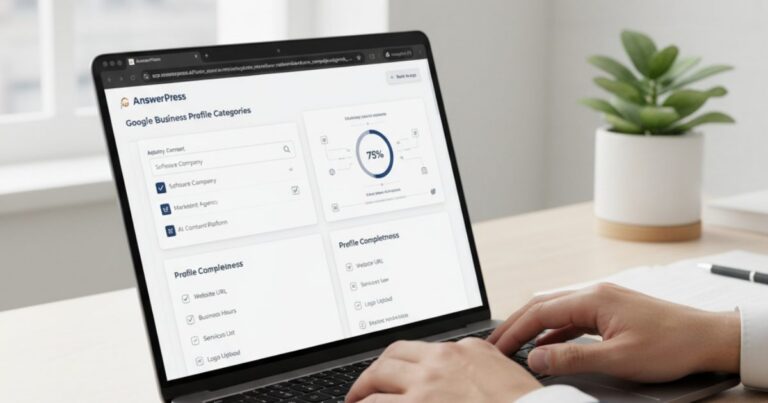
Your Google Business Profile (GBP) is no longer a simple directory listing. It is one of the primary, structured datasets that Google’s AI uses to understand and describe your local business. A poorly maintained or incomplete profile is a direct signal to the AI that your business is not a reliable source of information. According to 2025 data from Whitespark, GBP optimization still accounts for 33 percent of local pack ranking factors, a strong indication of its foundational importance for AI visibility.
To optimize your GBP for AI consumption, you must treat it as a dynamic source of information. This means going far beyond basic Name, Address, and Phone (NAP) consistency.
Complete Every Field: Fill out every available section of your profile. This includes services offered with detailed descriptions, all relevant attributes (e.g., “outdoor seating,” “wheelchair accessible”), precise business hours, and holiday hours. The more structured data you provide, the easier it is for the AI to categorize and recommend you.
Leverage Google Posts: Use Google Posts weekly. Share updates, promotions, new products, and events. Each post is a fresh piece of content, complete with text and images, that the AI can parse for timely information. A post about a “weekend special on rain gutter cleaning” directly answers a potential query.
Proactively Use Q&A: The Questions & Answers section is a goldmine. Do not wait for customers to ask questions. Populate this section yourself with common queries and provide clear, concise answers. Think about the specific questions your customers ask and answer them here. This creates a repository of ready-made answer snippets for Google AI Overviews.
Strategy 2: Cultivate and Respond to Reviews Across All Platforms
Reviews are a critical source of qualitative, real-world data for Google’s AI. The algorithm reads review text to understand public sentiment and extract specific details not included in your official business description. Phrases like “the staff was incredibly helpful with our toddler” or “the technician arrived within 20 minutes” are powerful signals of experience that the AI can use to construct its summaries. With consumer AI adoption for local recommendations jumping from 6% to 45% in a single year, according to BrightLocal, the importance of this user-generated content is immense.
Your review strategy must be comprehensive and active. It is not enough to simply have a good star rating. The AI is looking for volume, velocity, and substance.
Systematize Review Requests: Implement a consistent process for asking every satisfied customer to leave a review. Use email, SMS, or even a simple QR code at your place of business. The goal is a steady stream of new reviews.
Respond to Every Review: Acknowledge every review, both positive and negative. Your responses provide additional context for the AI and demonstrate to potential customers that you are engaged and value feedback.
Look Beyond Google: While Google reviews are crucial, AI models synthesize data from across the web. It is important to manage online reviews beyond Google on platforms like Yelp, Facebook, and industry-specific sites (e.g., Zillow for real estate, Avvo for law). A consistent reputation across multiple platforms builds trust.
Encourage Detailed Feedback: When requesting reviews, gently guide customers to be specific. Ask them to mention the service they received or the product they purchased. This detailed language is exactly what Google AI Overviews looks for when generating nuanced answers.
Strategy 3: Create Hyperlocal Content That Answers Specific Questions
The era of targeting broad keywords like “plumber in Seattle” is fading. AI-powered search excels at understanding nuance and long-tail queries. Data shows that longer, more complex queries are seven times more likely to trigger a Google AI Overview. Your content strategy must evolve to answer these highly specific, hyperlocal questions that your potential customers are asking. The goal is to become the definitive source of information for your niche within your specific service area.
This requires a shift from general marketing content to granular, service-area-focused resources. According to analysis from Search Engine Journal, adapting to AI means focusing on the specific problems and contexts of your local audience. This is how you demonstrate true local expertise.
Develop Neighborhood-Specific Pages: If you are a roofer in Chicago, create separate pages for neighborhoods like Lincoln Park, Wicker Park, and Hyde Park. Discuss common roofing issues in those areas, mention local architectural styles, and include testimonials from clients in those neighborhoods.
Write Question-Oriented Blog Posts: Brainstorm the exact questions your customers ask. A bakery should not just have a blog post about cakes; it should have a post titled “How to Order a Custom Wedding Cake in Austin, Texas” or “Where to Find the Best Gluten-Free Pastries in the 78704 ZIP Code.”
Incorporate Local Entities: Reference local landmarks, street names, parks, and community events in your content. This helps Google’s AI firmly ground your business’s identity within a specific geographic context, making it more likely to recommend you for “near me” searches.
Strategy 4: Implement Structured Data and Schema Markup
If your website content is a book, structured data (or schema markup) is the table of contents, index, and glossary all in one. It is a standardized vocabulary that you add to your website’s code to explicitly tell search engines what your content is about. For an AI tasked with quickly finding and synthesizing reliable information, schema is not optional; it is essential. It removes ambiguity and makes your data machine-readable, increasing the probability that the AI will trust and use it.
Implementing a schema does not require you to be a master coder, as many WordPress plugins and tools can assist. The key is to use the correct schema for the correct content type.
LocalBusinessThis is the most critical schema type for any local business. It allows you to explicitly define your business name, address, phone number, hours, and service area.ReviewUse this markup on your testimonials page to signal to the AI that this is user-generated review content, including the star rating and the review text.FAQPageIf you have a frequently asked questions page, use this schema to mark up the questions and answers. This makes your content a prime candidate to be pulled directly into an AI Overview.EventIf your business hosts events, workshops, or sales, use Event schema to define the date, time, location, and description.
Strategy 5: Build Demonstrable E-E-A-T for Local Trust
E-E-A-T stands for Experience, Expertise, Authoritativeness, and Trust. This is the framework Google’s human quality raters use to assess content, and its principles are hardwired into the algorithms that power Google AI Overviews. An AI will not recommend a business it does not trust. For a local business, E-E-A-T is not an abstract concept; it is built through tangible, real-world signals that you must showcase online.
As noted by experts who break down how AI impacts ranking signals, these trust factors are becoming more important than ever. Your job is to make your experience and trustworthiness impossible for the AI to ignore.
Experience: Show, do not just tell. Use photos and videos of your team at work. Create detailed case studies of projects you have completed in your service area.
Expertise: Publish detailed, helpful content that solves your customers’ problems. A local accountant could write an article on navigating city-specific business taxes. A landscaper could create a guide to planting a garden that thrives in the local climate.
Authoritativeness: Earn mentions and links from other respected local sources. This could be a feature in a local newspaper, a mention on a neighborhood blog, or a partnership with a complementary local business. These are powerful third-party endorsements.
Trust: Make your credentials prominent. Display business license numbers, professional certifications, and affiliations with organizations like the Better Business Bureau. Your “About Us” page should feature real photos and biographies of your key team members.
Strategy 6: Analyze and Adapt to AI-Cited Competitors
In the AEO era, your top competitors are not necessarily the ones ranking in the traditional organic results. Your real competitors are the businesses being cited in the Google AI Overviews for your most important local queries. Your strategy must include a continuous loop of competitive analysis focused on these AI-favored businesses. This is a core tenet of optimizing your content strategy for AI platforms.
Perform this analysis monthly to stay current with the AI’s preferences.
Identify the Cited: Regularly search for your main services and note which businesses are mentioned by name or linked in the AI Overview.
Deconstruct Their Profile: Conduct a deep dive into the cited competitor’s Google Business Profile. How complete is it? How frequently do they use Google Posts? What is the tone and substance of their Q&A section?
Analyze Their Reviews: Read their reviews carefully. What specific words and phrases do their customers use? The AI is clearly finding value in this language. Identify patterns you can encourage in your own customer feedback.
Audit Their Content: Examine the specific page that the AI linked to. What question does it answer? How is it structured? Is it a blog post, a service page, or a location page? Use this intelligence to identify gaps in your own content and create a better, more comprehensive resource.
Strategy 7: Prioritize Mobile Experience and Page Speed
This final strategy may seem like basic SEO, but its importance is amplified by Google AI Overviews. The journey from an AI-generated recommendation to a customer action is often immediate and almost always happens on a mobile device. Research from Nectafy shows that 88 percent of consumers who conduct a local search on their smartphone visit or call a store within 24 hours. If the AI cites your business and a user clicks through, your website must deliver a flawless experience.
A slow, clunky, or confusing mobile site is a dead end. It creates friction and causes the user to abandon the journey. Google’s systems can measure this user friction, and it can negatively impact your future visibility. Your technical foundation must be solid.
Test for Speed: Use Google’s PageSpeed Insights tool to analyze your site’s performance on mobile. Address the recommendations it provides, focusing on image optimization and reducing server response times.
Ensure Responsiveness: Your website must automatically adapt to any screen size. Text should be readable without pinching and zooming, and buttons must be easy to tap.
Reduce Friction to Conversion: Make it as easy as possible for a mobile user to take the next step. Your phone number should be a click-to-call link. Your address should link directly to Google Maps. Contact forms should be short and simple.
The rise of Google AI Overviews represents a significant challenge for local businesses, with 94 percent of them being invisible to AI platforms as of 2024. However, it also presents a clear opportunity. The businesses that move beyond the old SEO playbook and embrace a disciplined, data-driven strategy focused on becoming a citable authority will capture the most valuable, high-intent customers. The seven strategies outlined here are not just suggestions; they are the new requirements for success in local search. By mastering your data, cultivating your reputation, and creating genuinely helpful local content, you can ensure that when the AI answers, it recommends you.
This shift requires moving from guesswork to a strategic system. AnswerPress is a strategy engine built for this new era of search, helping you create the data-driven content that gets your business recommended by AI. If you are ready to adapt your content strategy for 2026 and beyond, contact us to learn more.
Frequently Asked Questions
What is the impact of Google AI Overviews on local search traffic?
Google AI Overviews have dramatically reduced traditional organic traffic for local businesses, with organic click-through rates dropping significantly when an AI Overview is present. The primary goal has shifted from ranking first in search results to being cited directly by the AI as the recommended business.
How does Google AI Overviews change the goal for local SEO?
The goal for local SEO has fundamentally changed from achieving a high rank in traditional search results to becoming the business that Google's AI recommends and cites within its AI Overviews. Being a cited source can lead to significantly more qualified clicks than traditional top rankings.
How should I optimize my Google Business Profile for AI Overviews?
Treat your Google Business Profile as a dynamic data source by completing every field, leveraging Google Posts weekly with timely information, and proactively populating the Q&A section with common customer questions and answers. This structured data helps the AI understand and recommend your business.
What role do customer reviews play in Google AI Overviews?
Customer reviews provide critical qualitative data that Google's AI analyzes for sentiment and specific details not found in official business descriptions. Systematically request reviews, respond to all feedback, and encourage customers to be specific about services received to provide the AI with rich, actionable content.
How can I ensure my website provides a good experience for users coming from AI Overviews?
Prioritize mobile experience and page speed, as users often act immediately on AI recommendations via their smartphones. Ensure your website is responsive, loads quickly, and minimizes friction for conversions, such as making phone numbers click-to-call and addresses link to maps.