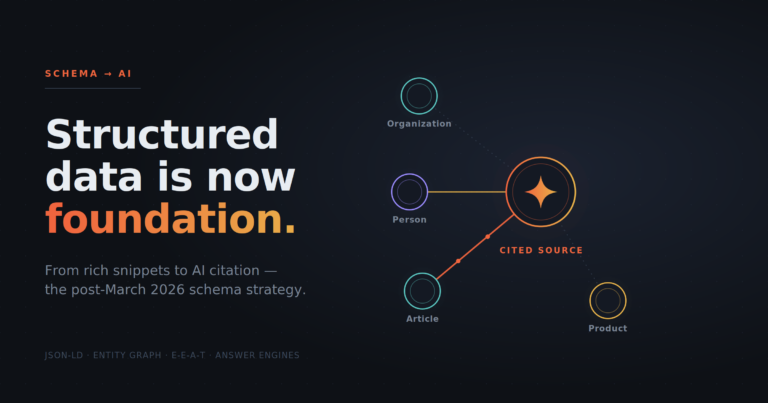

The old playbook for small business content marketing is closed. For years, the formula was straightforward: identify keywords, publish blog posts consistently, and hope for a gradual climb up Google’s list of ten blue links. That model is now obsolete. The widespread adoption of AI, particularly in search engines, has fundamentally restructured how customers find information and how businesses earn visibility. Your old content approach will not work in this new context. Success now requires a formal AI content strategy.
This is not about simply using an AI writer to produce articles faster. As of March 2026, 82 percent of small businesses were already using at least one AI tool. The advantage is no longer in adoption; it is in strategic implementation. A coherent AI content strategy moves beyond chasing production volume. It focuses on getting your business recommended and cited within AI-generated answers, the new front page of the internet. This requires a disciplined, data-driven process that aligns content with specific business objectives and the technical requirements of answer engines.
Why a Formal AI Content Strategy is Non-Negotiable
For a small business, resources are always constrained. Time, budget, and expertise are finite. In the past, content marketing often felt like a guessing game with an uncertain return. AI changes this dynamic, but only if applied with discipline. Simply adopting tools without a plan creates noise, not results. A formal AI content strategy provides the framework to turn AI from a novelty into a measurable growth engine.
The data confirms this shift. Small businesses implementing AI-driven campaigns report a 63 percent higher return on investment compared to traditional methods. Furthermore, 47 percent of small business owners saw a revenue boost after integrating AI, with an average increase of 21 percent. These results do not come from aimless experimentation. They are the product of a deliberate strategy.
Without a strategy, you risk wasting the very resources you hope to save. An average small business owner can save 10 to 20 hours per week by automating certain content tasks. But if that saved time is not reinvested into higher-value activities like strategy, verification, and distribution, the gains are minimal. Your competitors are already making this transition. With 85 percent of all marketers using AI for content creation in 2026, standing still means falling behind. The question is no longer if you should use AI, but how you will direct it to achieve specific business outcomes.
Step 1: Define Your Goals and Move Beyond Production Metrics
The first step in building a durable AI content strategy is defining clear business objectives. What do you want your content to achieve? The answer cannot be “to publish three blog posts a week.” That is a production metric, not a business goal. Effective goals are specific, measurable, and tied to revenue. Examples include:
- Increase qualified demo requests by 15 percent in the next quarter.
- Become the top cited source for “commercial HVAC repair in Seattle” in Google’s AI Overviews.
- Reduce inbound support tickets for common questions by 30 percent by creating a comprehensive, AI-discoverable knowledge base.
Once your goals are set, you can determine the role AI will play. It is crucial to distinguish between using AI as a production assistant and using it as a strategic partner. As one analysis of AI’s role in marketing explains, many businesses get stuck using AI tools just to generate content faster without a clear purpose. This leads to a higher volume of low-impact content that fails to get cited or drive conversions.
Your strategy must align AI-assisted production with your goals. If your objective is to be cited in AI Overviews, your focus should be on creating structured, factual, and verifiable content on a narrow set of topics. If your goal is lead generation, your AI content strategy should prioritize creating personalized content that addresses specific pain points at different stages of the buyer’s journey. The tool serves the strategy, not the other way around.
Step 2: Build Your AI-First Topic Model for AEO
The era of targeting individual keywords is over. Modern search, driven by AI, operates on concepts, entities, and topics. This is the foundation of Answer Engine Optimization (AEO). To be recommended by an AI, your website must demonstrate deep expertise and authority on a given subject. Your AI content strategy must be built around creating this topical authority, not just ranking for scattered keywords.
This process begins with building a topic model. A topic model is a structured map of the concepts and questions that define your area of expertise. Instead of starting with a keyword like “plumbing services,” you start with the core entity: “residential plumbing.” From there, you branch out into related subtopics:
- Emergency plumbing (leaks, burst pipes)
- Fixture installation (faucets, toilets)
- Drain cleaning (clogs, maintenance)
- Water heater services (repair, replacement)
For each subtopic, you must then identify the specific questions your potential customers are asking. These are the queries that will be fed into AI search platforms. Your content needs to answer these questions directly and comprehensively. This systematic approach ensures you cover your subject matter completely, leaving no gaps for competitors to fill. It signals to search engines that you are a definitive source of information. This is central to mastering the new rules of semantic search for AI-first visibility.
An AI-first strategy uses AI to accelerate this process. AI tools can analyze search data at scale to identify clusters of related topics, common user questions, and content gaps in the market. This data-driven approach removes the guesswork from content planning. It allows a small business to build a focused content plan that systematically establishes authority, making it more likely to be cited by AI answer engines.
Step 3: Select and Integrate Your AI Tool Stack
With a clear strategy and topic model, you can now select the right tools. The market is saturated with options, and it is easy to get overwhelmed. The average small business already uses five different AI tools, often creating a fragmented and inefficient workflow. The goal is to build an integrated system, not a collection of disconnected apps.
Your tool stack should support your entire end-to-end workflow, from strategy to publication. Consider the distinct stages of the content lifecycle:
- Strategy and Planning: Tools that help you build your topic model, analyze competitors, and generate content briefs based on search data and AEO principles.
- Drafting and Creation: AI writing assistants that can produce structured first drafts based on your detailed briefs. As of Q1 2026, 44 percent of small businesses were using AI for text composition.
- Media Generation: Tools for creating images, charts, and even video clips to accompany your text. Around 40 percent of small businesses use AI for this purpose.
- Optimization and Verification: Platforms that check for factual accuracy, provide SEO recommendations, and ensure content is properly structured with schema markup.
- Publishing and Distribution: Integrations that allow for one-click publishing to your CMS (like WordPress) and scheduling for social media.
A common mistake is focusing only on the drafting stage. An effective AI content strategy requires tools that support the entire process. Look for platforms that can act as a central “strategy engine,” connecting the dots between research, creation, and publishing. This minimizes context switching and ensures every piece of content aligns with the overarching plan. An integrated approach is how small businesses can achieve the reported 75 percent reduction in campaign launch times.
Step 4: Establish Your Grounding and Verification Workflow
Using AI to create content carries inherent risks. AI models can “hallucinate” facts, introduce subtle biases, or produce information that is outdated or simply incorrect. An AI content strategy is incomplete without a robust process for human oversight and verification. Trust is your most valuable asset, and publishing inaccurate information is the fastest way to destroy it.
Your workflow must include mandatory checkpoints for human review. This is not a suggestion; it is a requirement for responsible and effective AI use. Every piece of content generated with AI assistance should be reviewed by a human expert for:
- Factual Accuracy: Are all claims, statistics, and statements correct and supported by credible sources?
- Brand Voice and Tone: Does the content sound like it came from your business? Has the generic AI tone been edited out?
- Originality: Does the content add unique value, or is it a rehash of existing information? Does it pass plagiarism checks?
- Helpfulness: Does the content actually solve the user’s problem or answer their question completely?
This verification process is especially critical for AEO. AI answer engines prioritize sources they deem to be trustworthy and authoritative. Publishing unverified, low-quality AI output is a signal of untrustworthiness that can harm your long-term visibility. A key part of your strategy involves optimizing content specifically for the quality and structure that new AI search platforms reward. Your human expertise is your ultimate competitive advantage. AI can handle the initial draft, but the final stamp of approval and quality must come from you.
What a Matured AI Content Strategy Looks Like
When these steps are combined, the result is a powerful, efficient content engine. Consider a local electrician. In the past, they might have paid an agency to write generic blog posts about “the importance of licensed electricians.” The results were likely minimal.
With a mature AI content strategy, the approach is different. The electrician uses a strategy tool to build a topic model around “residential electrical services in Portland.” The system identifies dozens of specific customer questions, such as “cost to install a 240V outlet for an EV charger” and “how to know if my circuit breaker panel needs an upgrade.”
The platform generates detailed briefs for each topic. An AI assistant drafts factual, structured articles that directly answer these questions, including local cost averages and permit information. The electrician, the subject matter expert, spends 20 minutes reviewing each draft for accuracy and adding personal insights. The final, verified content is published to their WordPress site with correct schema markup. This methodical process is essential for success, particularly when targeting local search results in Google AI Overviews.
Within months, the electrician’s website becomes a trusted resource for electrical questions in their service area. Google’s AI Overviews begin citing their articles when users ask relevant questions. They are not just ranking; they are being recommended. This drives highly qualified traffic and phone calls, providing a measurable return on their content investment.
Stop Guessing. Start Strategizing.
The transition to an AI-first world of search is not a future event; it is happening now. For small businesses, this presents both a challenge and a significant opportunity. The tools to compete are more accessible than ever, but they are useless without a plan. An effective AI content strategy is the bridge between adopting technology and achieving real business growth.
Building this strategy requires a shift in mindset. You must move from a focus on volume to a focus on value, from keywords to topics, and from manual production to strategic automation. By defining clear goals, building a data-driven topic model, integrating your tools, and committing to human verification, you can create a content engine that consistently delivers measurable results. Stop guessing what content might work. It is time to implement a strategy that ensures it will.
AnswerPress is the strategy engine built for this new reality. It moves beyond simple AI writing to provide an end-to-end system for planning, creating, and publishing content that gets you recommended by AI. If you are ready to build a data-driven AI content strategy for your WordPress site, we can show you how.
Frequently Asked Questions
What is an AI content strategy and why is it important for small businesses?
An AI content strategy is a formal, data-driven plan that aligns AI-assisted content creation with specific business objectives, moving beyond simply producing more articles. It's crucial because the traditional content marketing playbook is obsolete due to AI's impact on search, and a strategy helps small businesses get recommended and cited by AI answer engines, driving measurable growth.
How does an AI content strategy differ from just using AI writing tools?
Simply using AI writing tools focuses on production volume and speed, often leading to low-impact content. A strategic approach uses AI as a partner to achieve specific business goals, like becoming a cited source in AI Overviews or increasing demo requests, by focusing on topical authority and structured, verifiable content.
What are the key business goals an AI content strategy should address?
An AI content strategy should focus on measurable, revenue-tied business goals rather than production metrics like publishing frequency. Examples include increasing qualified demo requests by a specific percentage, becoming the top cited source for a particular topic in AI Overviews, or reducing support tickets by creating discoverable knowledge bases.
How does an AI content strategy change how we approach keywords?
The era of targeting individual keywords is over; AI-driven search focuses on concepts, entities, and topics. An AI content strategy builds topical authority by creating a structured topic model around core entities and answering specific user questions comprehensively, which signals expertise to AI search engines.
What is the role of human verification in an AI content strategy?
Human verification is a mandatory checkpoint in an AI content strategy to ensure factual accuracy, brand voice, originality, and helpfulness. Publishing unverified AI output risks damaging trust and long-term visibility, as AI answer engines prioritize trustworthy and authoritative sources.